This article about Ann Taylor eliminating size 16 clothing from their stores despite the fact that the average American woman is larger than ever (mean: 164 pounds in 2002) offers several rationales for this decision:
(1) Plus-size clothing sales have dropped more than smaller-size clothing sales in the last year (8% vs. 2%, March 2008 to March 2009). I wonder if this is because the recession has hit a segment of the population who happens to be fatter harder than other segments? Or are larger women more likely to deal with tighter finances by reducing clothing purchases compared to smaller women, who may cut back elsewhere?
(2) It costs more to make larger clothing and since materials are the primary cost of clothing (since labor is cheap), this erodes profitability on these garments. While this may seem a bit off, given that an item in one size may not contain that much more fabric than the next size, anyone who has spent any time looking at clothing patterns knows that the issue is not just the fabric in the item, but the entire amount of fabric needed, including the waste. I have definitely seen patterns in which the jump in necessary fabric purchase between one size and the next is quite large since the bigger pattern pieces do not fit on a piece of fabric (which has a given width) in the same way, making much more waste.
(3) The distribution of women's body weights is such that although there are a lot of women who are, say, 200 pounds or more, there are fewer women in any one given high-weight category than in any given lower-weight category. So to capture all of the larger women, you need to offer a lot of different sizes. This is also offered as an explanation for the counter-intuitive fact that larger women, who could benefit greatly from more closely-tailored clothing, often are faced with less flattering but looser clothing options; garments made to fit loosely that incorporate stretch in the fabric can be worn by a wider range of large women. All I can say is it helps to learn to do some basic sewing; to create a more streamlined silhouette, darts are your friend. And larger women may just have to buck it up and spend more on items from specialty stores that cater to their size range.
One thing that isn't mentioned in the article is whether larger women are just less into buying clothes than smaller women and thus even if there were the same number of women who wear a size 16 as wear a size 8, the size 16's shop less and spend less on clothing. I know from personal experience that I enjoy clothes shopping a lot more at 135 pounds than at 155.
It's also a rather sad situation that body politics has pitted plus-sized and extra-small women against each other, with the former sometimes raging against the mere existence of the size 0 or size 00 as a personal insult. Finding clothes that fit can be a challenge for anybody, no matter the weight or size. Even a woman with an utterly enviable weight and size has her own difficulties finding garments that match up with her personal shape.
Tuesday, June 30, 2009

Monday, June 29, 2009
Sally's Closet: The Cat of Time Hill
Going through my closets has turned up some dubious treasures, including selections of my childhood storytelling. I wrote a few books about the same two characters, Strawly the cat and his friend Rit the rat, "who live in Talaperosicy, somewhere in the south."
The best of the series is The Cat of Time Hill, in which our protagonists are captured by an alien (the unicorn figure) and taken by rocket to meet his ruler (the bull figure - the gaudy necklace denotes his status) on Time Hill, leading to this dramatic encounter:

The ruler asks "What value do you things have?" prompting the rejoinder from Rit, "We are not 'things,' we are animals, and we want to get out of here."
The ruler remains unmoved by this brave display and instructs his henchman to put them in a cell. Rit observes, "We will have a hard time getting out of this one."
The next day the ruler and his minion meet with Rit and Strawly to discuss "some of the facts on what was going to happen" to them...but, through some freak occurrence, the ruler falls into a conveniently located pool. And because he cannot swim (despite having chosen to have this conversation next to this pool), he starts to drown. Strawly rescues the ruler from certain death, and the ruler offers to give him anything he wants. Strawly wants Rit and himself to be taken home. As the henchman walks them toward the rocket for the return journey, the story closes as an unspecified "everyone cheered and yelled 'Strawly is the Cat of Time Hill!'" (It is unclear what "everyone" was doing while the ruler was drowning. Perhaps none of these aliens could swim.)
I believe this was the central Rit and Strawly plot: the animals gain their liberty from a villain through some kind of courageous, generous act. But the first story, The Adventures of Strawly and Rit, instead relates the introduction of Rit to Strawly's good friends, a hound named Ronald (who wields an eerily phallic baseball bat) and a bird named Susie (who, incidentally, appears to be the only one with a job), and the party-turned-sleepover-in-the-woods that ensues.

Despite the amiability of Ronald and Susie, Rit is clear to become Strawly's BFF and it is no surprise to the reader that he is the sidekick who is featured in later stories.
The best of the series is The Cat of Time Hill, in which our protagonists are captured by an alien (the unicorn figure) and taken by rocket to meet his ruler (the bull figure - the gaudy necklace denotes his status) on Time Hill, leading to this dramatic encounter:

The ruler asks "What value do you things have?" prompting the rejoinder from Rit, "We are not 'things,' we are animals, and we want to get out of here."
The ruler remains unmoved by this brave display and instructs his henchman to put them in a cell. Rit observes, "We will have a hard time getting out of this one."
The next day the ruler and his minion meet with Rit and Strawly to discuss "some of the facts on what was going to happen" to them...but, through some freak occurrence, the ruler falls into a conveniently located pool. And because he cannot swim (despite having chosen to have this conversation next to this pool), he starts to drown. Strawly rescues the ruler from certain death, and the ruler offers to give him anything he wants. Strawly wants Rit and himself to be taken home. As the henchman walks them toward the rocket for the return journey, the story closes as an unspecified "everyone cheered and yelled 'Strawly is the Cat of Time Hill!'" (It is unclear what "everyone" was doing while the ruler was drowning. Perhaps none of these aliens could swim.)
I believe this was the central Rit and Strawly plot: the animals gain their liberty from a villain through some kind of courageous, generous act. But the first story, The Adventures of Strawly and Rit, instead relates the introduction of Rit to Strawly's good friends, a hound named Ronald (who wields an eerily phallic baseball bat) and a bird named Susie (who, incidentally, appears to be the only one with a job), and the party-turned-sleepover-in-the-woods that ensues.

Despite the amiability of Ronald and Susie, Rit is clear to become Strawly's BFF and it is no surprise to the reader that he is the sidekick who is featured in later stories.
Friday, June 26, 2009
Idiotic Offer
Bank of America sent me junk mail exhorting me: "If you're going to spend, spend smart."(tm)
Their extra-special offer is that between now and Sept. 1, all "restaurant and entertainment" purchases on my credit card will qualify for a promotional APR of 1.99% rather than 10.99%.
So basically, if I spend money on restaurants, resorts, etc., that I cannot afford and hence am going to have to pay interest on, I can save a tiny amount of money on the interest. What an amazingly generous offer. "Why wait?" indeed. I should forget about staying home this summer. Clearly, I should take an expensive vacation to Hawaii or something so that I can "take advantage of the lower rate." At least, I assume that this is what they have in mind.
Alternatively, I can save even more by not spending money I don't even have on something as frivolous and optional as a summer vacation or local restaurant meals.
Their extra-special offer is that between now and Sept. 1, all "restaurant and entertainment" purchases on my credit card will qualify for a promotional APR of 1.99% rather than 10.99%.
So basically, if I spend money on restaurants, resorts, etc., that I cannot afford and hence am going to have to pay interest on, I can save a tiny amount of money on the interest. What an amazingly generous offer. "Why wait?" indeed. I should forget about staying home this summer. Clearly, I should take an expensive vacation to Hawaii or something so that I can "take advantage of the lower rate." At least, I assume that this is what they have in mind.
Alternatively, I can save even more by not spending money I don't even have on something as frivolous and optional as a summer vacation or local restaurant meals.
Ecru Threads
It's always a nice thing when I can use laziness to work to my advantage (see: "God, I want a bowl of popcorn...nah, not willing to go to the store to get any").
Yesterday, I used the fact that I always feel a sense of reluctance about changing the thread in my sewing machine (which doesn't take much time, but is one of those tiny barriers that can derail a person) to motivate myself to find things to sew that use the ecru thread I still had in the machine from the organic Anthem tank.
Item 1: 20+ year old pants become semi-billowy shorts
It seems almost incredible that I could be wearing a pair of pants that I purchased prior to the fall of the Berlin Wall, but there it is. Actually, I haven't worn them much for a couple of years because they were too short even by my standards, but I really liked them. I don't think this is due to some kind of sentimental attachment but more just the simple fact that they are unusual in style, cool for summer (literally - thin cotton), and have a nice loose fit in the legs that is very comfortable. They always make me feel like I'm on an island vacation (which is, frankly, pretty weird when I articulate it). They are also rather high-waisted, which would look funny if I were to tuck something into them, but there's no risk of that happening.
I didn't seem to be able to take a photo that didn't make one leg or the other look longer than its partner (because I can't manage to stand up straight), but in reality, they are the same length.

I'm pretty pleased that I will be able to get continued wear out of these old favorites.
Item 2: Unwearable free t-shirt becomes custom-fitted shirt
Honestly, a lot of the free t-shirts a person accumulates are not very attractive (I mean, given away free, not "free to me" shirts that someone paid for but you were given). Mine tend to be advertising some company or organization that I may not want to pimp for, commemorate an event that I don't care much about (often with sponsor logos also), ugly, or all three. (A possible exception: the Salon t-shirts that Tam gave me that I remade into two tanks, but I don't know whether Tam paid for them or not.)
So when I got this free event t-shirt, that had no logos but a really nice design, I was quite happy. Unfortunately, it had the problems all true "T"-shirts have - its shape did not at all match mine. Fortunately, while my sewing skills are rudimentary at best, I am able to fix this kind of problem. In this case, after having made so many sleeveless shirts recently, I decided to remake it into a short-sleeved shirt.
My favorite t-shirts to refashion are huge - the bigger, the better. This one was a size medium, which made it a bit tricky since to get the length I wanted, it would be tighter around the hips than I prefer, and I generally had less room getting my desired shape with a reasonable seam allowance.
I used my youth birding (Roughwings) t-shirt refashion as the basis for the new shirt. What? I can't find a photo of this shirt on my blog, so here it is. (This was one of many shirts I purchased super-cheap from my previous employer.) I have forgotten what store-bought shirt of my own I used as the original model for the Roughwings shirt, which has become one of my favorite shirts to wear, esp. birding because (1) it's a birding event shirt and (2) cream and green match my typical birding gear.
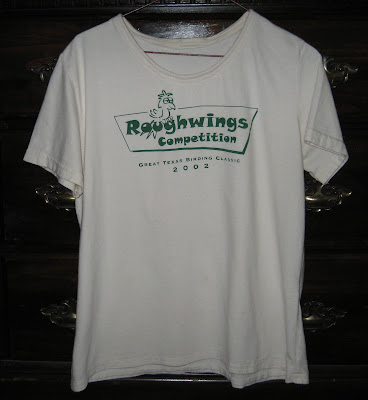
The flare of the Roughwings shirt was too wide to work within the confines of a size medium t-shirt, so I did a planned-out version of something I faked after-the-fact with another refashion: I incorporated a cut-away at the side of the shirt.

I surprised myself at how well I did with resizing and attaching the sleeves. It had been so long since I'd done that, I had to figure it all out as if for the first time. (It's actually more challenging than you might think to determine how to orient the body and the sleeve to sew the sleeve on from the inside.) The sleeves are, basically, perfect.
I managed to make this photo look weird by having the shirt a bit off-center at the shoulder but you can see the shape and most importantly, the design.

Male and female belted kingfishers! I am so glad I didn't screw this one up. Kingfishers are my favorite. I love them. I don't even care about the semi-hokey "Soaring to New Heights" motto underneath the event information.
Yesterday, I used the fact that I always feel a sense of reluctance about changing the thread in my sewing machine (which doesn't take much time, but is one of those tiny barriers that can derail a person) to motivate myself to find things to sew that use the ecru thread I still had in the machine from the organic Anthem tank.
Item 1: 20+ year old pants become semi-billowy shorts
It seems almost incredible that I could be wearing a pair of pants that I purchased prior to the fall of the Berlin Wall, but there it is. Actually, I haven't worn them much for a couple of years because they were too short even by my standards, but I really liked them. I don't think this is due to some kind of sentimental attachment but more just the simple fact that they are unusual in style, cool for summer (literally - thin cotton), and have a nice loose fit in the legs that is very comfortable. They always make me feel like I'm on an island vacation (which is, frankly, pretty weird when I articulate it). They are also rather high-waisted, which would look funny if I were to tuck something into them, but there's no risk of that happening.
I didn't seem to be able to take a photo that didn't make one leg or the other look longer than its partner (because I can't manage to stand up straight), but in reality, they are the same length.

I'm pretty pleased that I will be able to get continued wear out of these old favorites.
Item 2: Unwearable free t-shirt becomes custom-fitted shirt
Honestly, a lot of the free t-shirts a person accumulates are not very attractive (I mean, given away free, not "free to me" shirts that someone paid for but you were given). Mine tend to be advertising some company or organization that I may not want to pimp for, commemorate an event that I don't care much about (often with sponsor logos also), ugly, or all three. (A possible exception: the Salon t-shirts that Tam gave me that I remade into two tanks, but I don't know whether Tam paid for them or not.)
So when I got this free event t-shirt, that had no logos but a really nice design, I was quite happy. Unfortunately, it had the problems all true "T"-shirts have - its shape did not at all match mine. Fortunately, while my sewing skills are rudimentary at best, I am able to fix this kind of problem. In this case, after having made so many sleeveless shirts recently, I decided to remake it into a short-sleeved shirt.
My favorite t-shirts to refashion are huge - the bigger, the better. This one was a size medium, which made it a bit tricky since to get the length I wanted, it would be tighter around the hips than I prefer, and I generally had less room getting my desired shape with a reasonable seam allowance.
I used my youth birding (Roughwings) t-shirt refashion as the basis for the new shirt. What? I can't find a photo of this shirt on my blog, so here it is. (This was one of many shirts I purchased super-cheap from my previous employer.) I have forgotten what store-bought shirt of my own I used as the original model for the Roughwings shirt, which has become one of my favorite shirts to wear, esp. birding because (1) it's a birding event shirt and (2) cream and green match my typical birding gear.

The flare of the Roughwings shirt was too wide to work within the confines of a size medium t-shirt, so I did a planned-out version of something I faked after-the-fact with another refashion: I incorporated a cut-away at the side of the shirt.

I surprised myself at how well I did with resizing and attaching the sleeves. It had been so long since I'd done that, I had to figure it all out as if for the first time. (It's actually more challenging than you might think to determine how to orient the body and the sleeve to sew the sleeve on from the inside.) The sleeves are, basically, perfect.
I managed to make this photo look weird by having the shirt a bit off-center at the shoulder but you can see the shape and most importantly, the design.

Male and female belted kingfishers! I am so glad I didn't screw this one up. Kingfishers are my favorite. I love them. I don't even care about the semi-hokey "Soaring to New Heights" motto underneath the event information.
Thursday, June 25, 2009
North Carolina Zoo: A Photo Tour
Toward the end of our trip to NC, we went to the North Carolina Zoo (which is run by the state). The zoo is located in the Uwharrie Mountains, one of the oldest mountain ranges in North America and thus somewhat more eroded than most. Nevertheless, the terrain in the zoo was rather hilly, and walking the trails in their entirety (including doubling back over a lot of them) was good exercise; there are over 5 miles of trail. Fortunately, the weather was pleasant - warm, but with a nice breeze - and there was excellent shade because the landscaping of the zoo left a lot of trees. They definitely went for "natural" in their habitats too, rather than cages and bars, and everything looked great. The zoo contains two areas - Africa and North America - connected by a trail (and mini-train service).
We started in the Africa Forest Edge area with giraffes. I thought the landscaping here was particularly nice.
We started in the Africa Forest Edge area with giraffes. I thought the landscaping here was particularly nice.

The male lion in the African Bushlands area was sleepy and seemed content to let us get great, close views and photographs of him in his glory.
I was surprised how much I liked the tropical plant area of the African pavilion, especially the orchids. (I would have spent more time in there but it was really warm and muggy, as one might expect of an indoor tropical plant exhibit.)
One type of orchid:
Many types of orchid all together:
I also finally saw what a tamarind tree looks like (though sorry, no photo - it wasn't very photogenic) and learned a bit about it:
Tamarindis indica
Family: Fabaceae—Pea family
Origin: Tropical Africa
Native to tropical Africa, the tamarind tree grows wild throughout the Sudan. The fruit was well known to Egyptians and Greeks in the 4th Century B.C. The pulp from the fruit is an important ingredient in chutneys, curries and sauces, including some brands of Worcestershire and barbeque sauces. Sugared tamarind pulp is often prepared as a confection and tamarind ade has long been a popular drink in the tropics.
Of course, I was struck by this African eagle...well, not literally. I don't want to think about how much damage this guy could do if he decided to attack me.
The Watani Grasslands exhibit was really nice - a very large, open area visible in its entirety from a high vista but with a pathway system (outside the grasslands area) that allowed you to get close to various of the animals.
It's rather amusing to watch an African elephant, the world's largest land mammal, eating grass. (Apparently an adult elephant consumes 300-600 lb. of plant matter a day.)
The Chilean flamingo can be distinguished from other species by its pink knees.
I don't know what kind of flower this is, but I liked its waxy appearance.
Possibly my favorite part of the zoo was (predictably) the aviary. Robert had been extremely smart to suggest that we bring our binoculars into the zoo, and we used them everywhere (sometimes to the visible or audible envy of other visitors), but they were particularly useful for identifying birds.
My absolute favorite was the grey-headed kingfisher, of course; the guide described this specific bird: "This friendly kingfisher was hatched in 1986. He is usually easy to find, being very comfortable around visitors." And indeed, he was, but unfortunately, my photos did not turn out very well despite repeated efforts; you can at least see his wonderful bill in this photo.
I was also charmed by this extremely cooperative fairy bluebird (of Southeast Asia) with the bright red eye.
I could have stayed in the aviary all day, but we needed to move on to the North America exhibits.
In the Cypress Swamp, there were many lazy alligators lying about.
Also this beautiful big cat, a cougar, who posed magnificently. (Look at those paws, *swoon*)
At this point, my energy and interest levels were beginning to flag and my knee was not very happy with me, so I did not bother taking photos of any of the many, many North American animals that remained in the various exhibits. I did enjoy our sojourn in the Sonora Desert, where we saw all kinds of familiar things - cactus, birds, lizards, and so on. The arctic fox is also really pretty.
But...no rabbits! What?! It was a disappointment. But we did not lack for seeing rabbits during our time in NC. We saw wild rabbits a few times, including once on a residential street in Charlotte the day we left town.
The funniest animal sighting was at the SciWorks science museum in W-S. There was a section of animal exhibits, predominantly reptiles, and at the end of it, I was watching a large iguana make a mess with his salad lunch when Robert said, "Sally, turn around." Now Robert and I have a checkered history with these kinds of exhibits (including the infamous flying cockroach incident at the Fort Worth Zoo) so I was a bit hesitant and, okay, almost scared to see what monstrous reptile he was looking at. I turned and saw...a lop rabbit. "Oh god, what kind of horrible creature are they feeding this sweet bunny to!" I briefly wondered. I looked at the sign. It said: Domestic Rabbit. Oh, the bunny is the horrible creature! He was a cutie (though, in all honesty, not quite as lovely as my own Leo).
Wednesday, June 24, 2009
Applicant Credentials
Yesterday, I discovered yet another grad school application forum, and I've been looking through the posts for anything relevant to my situation. (This has distracted me from other things I planned to do today, but oh well.)
One thing I have come away with from looking at these various discussions over the past 2 years is that applicant credentials are more impressive today than when I graduated from college, and was first contemplating grad school, in 1996. (We've already seen evidence that successful business PhD applicants today have higher GMAT scores than those of only a couple years ago.)
Overall, GPA's of 3.5 are discussed as though they are merely OK but not very good. In the humanities, GPA of 3.8 or higher is considered solid. But this is consistent with what we've already heard about grade inflation from various sources, including the TAMU data that showed significant grade inflation for humanities subjects as well as moderate inflation among the social sciences. So it's unclear whether today's grad school applicants have "better" grades when adjusting for this inflation problem.
In the research sciences (including fields such as biology, chemistry, psychology, and sociology), there is an increasing expectation that applicants will already have extensive research experience. For example, psychology students with "merely" a couple of years experience working in a professor's lab are considered borderline for application. Science students are counseled to do a couple years post-bach lab work to be competitive for PhD programs, as are clinical psychology hopefuls. Publications by undergrads are much more common than they were in 1996; while some of these are in undergraduate journals or student conferences, others are in "real" journals.
Comparing current advice to psychology applicants (such as these forums but also on university web pages) to that from the 1990's and early 2000's shows a much greater emphasis on the amount and quality of research experience. It used to be that letters of recommendation noting a student's "aptitude" for research was sufficient, but today, those letters need to demonstrate that the student has already undertaken research and excelled at it.
Successful economics grad applicants are, to a greater extent than ever, those with the highest level of math ability and background (though this is a valid criterion, given that the discipline has been moving in a consistently mathier direction, perhaps for lack of other ideas, I cannot help but snarkily observe).
And while it isn't true, it seems that every serious grad school hopeful and their dog (or cat or both) has done at least one undergraduate thesis.
I can't speak to what applicants to math PhD programs used to look like, but I've been sort of blown away by how precocious many of today's students are. Many people seem to be on extremely accelerated tracks. One student made me laugh when she said she took Calc 2 as a sophomore...in high school. I was amazed to read threads on topics such as "Is it OK that I continue taking undergrad math courses through my sophomore year and only start graduate classes as a junior? I know this puts me behind, but I think I would benefit from it" in which nobody accuses the original poster of being a troll - rather, they discuss this as though it's a serious issue. Who are these people? Where do they come from? Are they the forerunners of Uber-Geek Wesley Crusher?
Obviously, the people who post to these sites are not representative of all applicants. I'm sure these forums attract a lot of highly qualified people, some of whom may post questions about their stats as a form of bragging or because they are afraid that they will not reach the goal they've had since they were 6 of getting into the #1 PhD program in their field. The more clueless applicants may not even be on top of things enough to be reading the boards, let alone posting on them. Also, foreign students seem over-represented on some forums (as many people have observed), and the common wisdom I have heard is that they tend to have slightly better stats on paper (e.g. GRE scores) than American students (but may have weaker statements, recommendations, and other "soft" stuff) - I have no idea whether this is accurate or not.
But it sort of makes sense that today's PhD applicants (or at least, the top X% of today's applicants, who are the serious contenders) would have more impressive qualifications than those of years past. Just as parents appear to start grooming their children for successful undergraduate acceptance to Harvard at the age of 4 with placement in a "good" pre-school and keep up the focus on impressive achievement through high school, there's been an arms race in graduate admissions as well. More people are applying for the same number of (or in some cases, like business PhD, fewer) slots and more is known about what are the characteristics of a successful applicant in a given field. Who knows - maybe 10 years from now, humanities students will be expected to speak 6 languages prior to their acceptance to PhD programs.
I have heard (personally) and read many times current grad students or professors comment that they believe they themselves (or various of their colleagues, usually left un-named) would have a much harder time being competitive against today's applicants. I know I wouldn't particularly like to move my 1996 self up to fight for a spot in a social psychology PhD program today (2nd only to clinical in competitiveness among psych programs).
Of course, many of us oldsters would probably have the honors thesis, the publications, the grades, etc., if we were actually part of today's cohort because those things would be expected and encouraged by our undergrad advisors; it's not that I think that these young kids are necessarily actually smarter or more talented, but that they have certain kinds of experiences at an earlier point and may be better prepared for grad school.
Sadly, despite this superior preparation, it doesn't seem to be taking any less time for people to get their PhD, and even at the conference I attended a couple weeks ago, current professors were talking about how the expectations have changed in terms of having publications during one's doctoral program (something that used to be rare in the field of academic marketing) in order to be a serious job applicant.
High school juniors - I hope you are spending this summer working your way through a real analysis textbook if you want to have any chance of ever getting a PhD in a quantitative field.
One thing I have come away with from looking at these various discussions over the past 2 years is that applicant credentials are more impressive today than when I graduated from college, and was first contemplating grad school, in 1996. (We've already seen evidence that successful business PhD applicants today have higher GMAT scores than those of only a couple years ago.)
Overall, GPA's of 3.5 are discussed as though they are merely OK but not very good. In the humanities, GPA of 3.8 or higher is considered solid. But this is consistent with what we've already heard about grade inflation from various sources, including the TAMU data that showed significant grade inflation for humanities subjects as well as moderate inflation among the social sciences. So it's unclear whether today's grad school applicants have "better" grades when adjusting for this inflation problem.
In the research sciences (including fields such as biology, chemistry, psychology, and sociology), there is an increasing expectation that applicants will already have extensive research experience. For example, psychology students with "merely" a couple of years experience working in a professor's lab are considered borderline for application. Science students are counseled to do a couple years post-bach lab work to be competitive for PhD programs, as are clinical psychology hopefuls. Publications by undergrads are much more common than they were in 1996; while some of these are in undergraduate journals or student conferences, others are in "real" journals.
Comparing current advice to psychology applicants (such as these forums but also on university web pages) to that from the 1990's and early 2000's shows a much greater emphasis on the amount and quality of research experience. It used to be that letters of recommendation noting a student's "aptitude" for research was sufficient, but today, those letters need to demonstrate that the student has already undertaken research and excelled at it.
Successful economics grad applicants are, to a greater extent than ever, those with the highest level of math ability and background (though this is a valid criterion, given that the discipline has been moving in a consistently mathier direction, perhaps for lack of other ideas, I cannot help but snarkily observe).
And while it isn't true, it seems that every serious grad school hopeful and their dog (or cat or both) has done at least one undergraduate thesis.
I can't speak to what applicants to math PhD programs used to look like, but I've been sort of blown away by how precocious many of today's students are. Many people seem to be on extremely accelerated tracks. One student made me laugh when she said she took Calc 2 as a sophomore...in high school. I was amazed to read threads on topics such as "Is it OK that I continue taking undergrad math courses through my sophomore year and only start graduate classes as a junior? I know this puts me behind, but I think I would benefit from it" in which nobody accuses the original poster of being a troll - rather, they discuss this as though it's a serious issue. Who are these people? Where do they come from? Are they the forerunners of Uber-Geek Wesley Crusher?
Obviously, the people who post to these sites are not representative of all applicants. I'm sure these forums attract a lot of highly qualified people, some of whom may post questions about their stats as a form of bragging or because they are afraid that they will not reach the goal they've had since they were 6 of getting into the #1 PhD program in their field. The more clueless applicants may not even be on top of things enough to be reading the boards, let alone posting on them. Also, foreign students seem over-represented on some forums (as many people have observed), and the common wisdom I have heard is that they tend to have slightly better stats on paper (e.g. GRE scores) than American students (but may have weaker statements, recommendations, and other "soft" stuff) - I have no idea whether this is accurate or not.
But it sort of makes sense that today's PhD applicants (or at least, the top X% of today's applicants, who are the serious contenders) would have more impressive qualifications than those of years past. Just as parents appear to start grooming their children for successful undergraduate acceptance to Harvard at the age of 4 with placement in a "good" pre-school and keep up the focus on impressive achievement through high school, there's been an arms race in graduate admissions as well. More people are applying for the same number of (or in some cases, like business PhD, fewer) slots and more is known about what are the characteristics of a successful applicant in a given field. Who knows - maybe 10 years from now, humanities students will be expected to speak 6 languages prior to their acceptance to PhD programs.
I have heard (personally) and read many times current grad students or professors comment that they believe they themselves (or various of their colleagues, usually left un-named) would have a much harder time being competitive against today's applicants. I know I wouldn't particularly like to move my 1996 self up to fight for a spot in a social psychology PhD program today (2nd only to clinical in competitiveness among psych programs).
Of course, many of us oldsters would probably have the honors thesis, the publications, the grades, etc., if we were actually part of today's cohort because those things would be expected and encouraged by our undergrad advisors; it's not that I think that these young kids are necessarily actually smarter or more talented, but that they have certain kinds of experiences at an earlier point and may be better prepared for grad school.
Sadly, despite this superior preparation, it doesn't seem to be taking any less time for people to get their PhD, and even at the conference I attended a couple weeks ago, current professors were talking about how the expectations have changed in terms of having publications during one's doctoral program (something that used to be rare in the field of academic marketing) in order to be a serious job applicant.
High school juniors - I hope you are spending this summer working your way through a real analysis textbook if you want to have any chance of ever getting a PhD in a quantitative field.
Tuesday, June 23, 2009
Government Debt: Boomer Edition
The Economist has an excellent article about government debt, a subject increasingly worthy of attention given that "by next year the gross public debt of the ten richest countries attending the summits of the G20 club of big economies will reach 106% of GDP, up from 78% in 2007."
Obviously, the finance meltdown is a big problem, but perhaps not the largest one:
"In America, for instance, Barack Obama’s administration has ambitious plans for broader health-care coverage, though it promises to pay for it. Worse, the biggest peacetime jump in the rich world’s public debt is taking place just before a slow, secular collapse in most countries’ public finances as workers age and the costs of health care rise. According to the IMF’s calculations, the present value of the fiscal cost of an ageing population is, on average, ten times that of the financial crisis. Left unchecked, demographic pressures will send the combined public debt of the big rich economies towards 200% of GDP by 2030....The present value of the increase in America’s future age-related budget obligations is about five times its GDP."
If Barack Obama actually manages to pull off that frequently-mentioned yet never-realized fantasy of financing more government stuff through amazing cost savings, I'll eat your hat. But that aside, what is being done about the known serious problem of the aging US population? Jack all. However, the writers at The Economist are singing the same tune I am (and no, it doesn't involve enactment of a Logan's Run type scheme):
"The best way out is to tackle the costs of ageing head-on by, for instance, raising retirement ages further. That would brighten the medium-term fiscal outlook without damaging demand now. Broadly, spending cuts should be preferred to tax increases. And rather than raise tax rates, governments would do better to improve their tax codes, broadening the base and eliminating distortive loopholes (such as preferential treatment of housing). Other priorities will vary from one country to the next. But after today’s borrowing binge, doing nothing is no longer an option."
To me, it is unconscionable that the retirement age is so low, given the impending bust of Social Security and the increases in life expectancy. I also think that the tax deductions for people with mortgages is blatantly unfair (esp. given that I feel confident that poor people are less likely to own a home than richer people). I'd love to see both of these things fixed.
Obviously, the finance meltdown is a big problem, but perhaps not the largest one:
"In America, for instance, Barack Obama’s administration has ambitious plans for broader health-care coverage, though it promises to pay for it. Worse, the biggest peacetime jump in the rich world’s public debt is taking place just before a slow, secular collapse in most countries’ public finances as workers age and the costs of health care rise. According to the IMF’s calculations, the present value of the fiscal cost of an ageing population is, on average, ten times that of the financial crisis. Left unchecked, demographic pressures will send the combined public debt of the big rich economies towards 200% of GDP by 2030....The present value of the increase in America’s future age-related budget obligations is about five times its GDP."
If Barack Obama actually manages to pull off that frequently-mentioned yet never-realized fantasy of financing more government stuff through amazing cost savings, I'll eat your hat. But that aside, what is being done about the known serious problem of the aging US population? Jack all. However, the writers at The Economist are singing the same tune I am (and no, it doesn't involve enactment of a Logan's Run type scheme):
"The best way out is to tackle the costs of ageing head-on by, for instance, raising retirement ages further. That would brighten the medium-term fiscal outlook without damaging demand now. Broadly, spending cuts should be preferred to tax increases. And rather than raise tax rates, governments would do better to improve their tax codes, broadening the base and eliminating distortive loopholes (such as preferential treatment of housing). Other priorities will vary from one country to the next. But after today’s borrowing binge, doing nothing is no longer an option."
To me, it is unconscionable that the retirement age is so low, given the impending bust of Social Security and the increases in life expectancy. I also think that the tax deductions for people with mortgages is blatantly unfair (esp. given that I feel confident that poor people are less likely to own a home than richer people). I'd love to see both of these things fixed.
Subscribe to:
Posts (Atom)
